How to talk about money with your partner without fighting
The opening sentence word for word, a 45 minute agenda in four blocks, three topics to keep out of the first talk, and how to stop a fight mid-way.
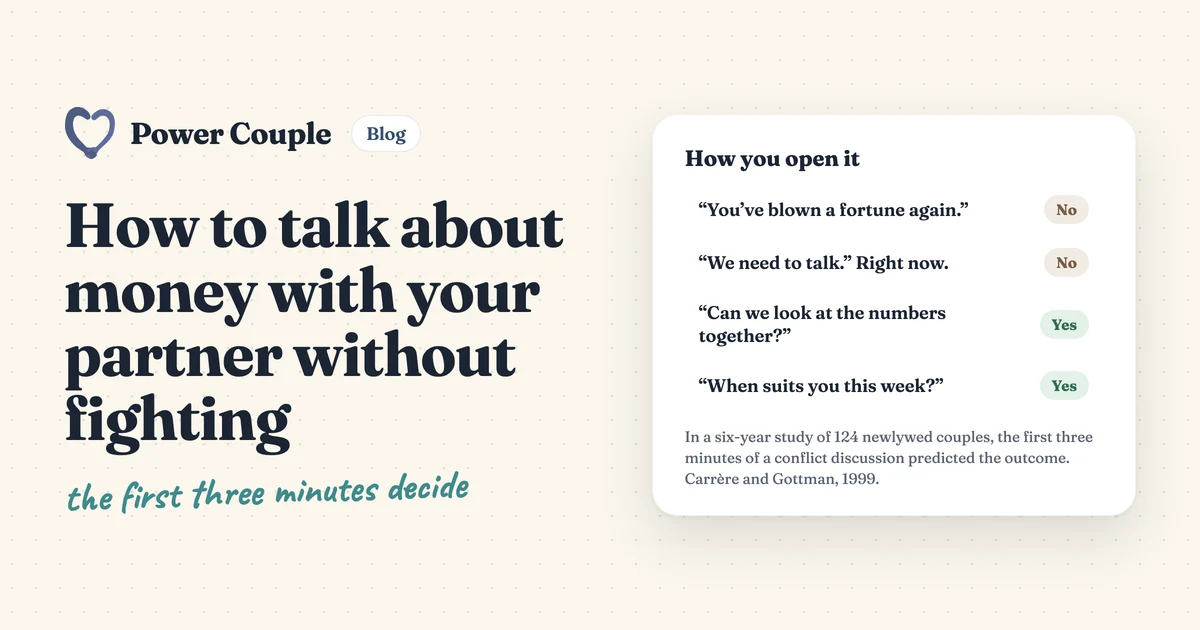
Don't open with the numbers. Say in one sentence what you want, with no accusation and no demand attached, and agree on a time. Then 45 minutes in four blocks. What went well, the numbers, one decision, the next date. Keep three topics out of the first talk. And if it turns into a fight anyway, stop and name a specific time to come back, because "later" never arrives on its own. Everything below is what to say, and when.
Key Takeaways
- The opening matters more than the rest. In a six-year study, the first three minutes of a conflict discussion predicted how the marriage went.
- Forty-five minutes is enough, and it beats a "let's sort everything out" evening.
- Leave your partner's family, old settled decisions, and the big long-term plans out of the first talk.
- In a study of 4,574 couples, financial disagreements predicted divorce more strongly than other common disagreements. It isn't how much money you have, it's how you talk about it.
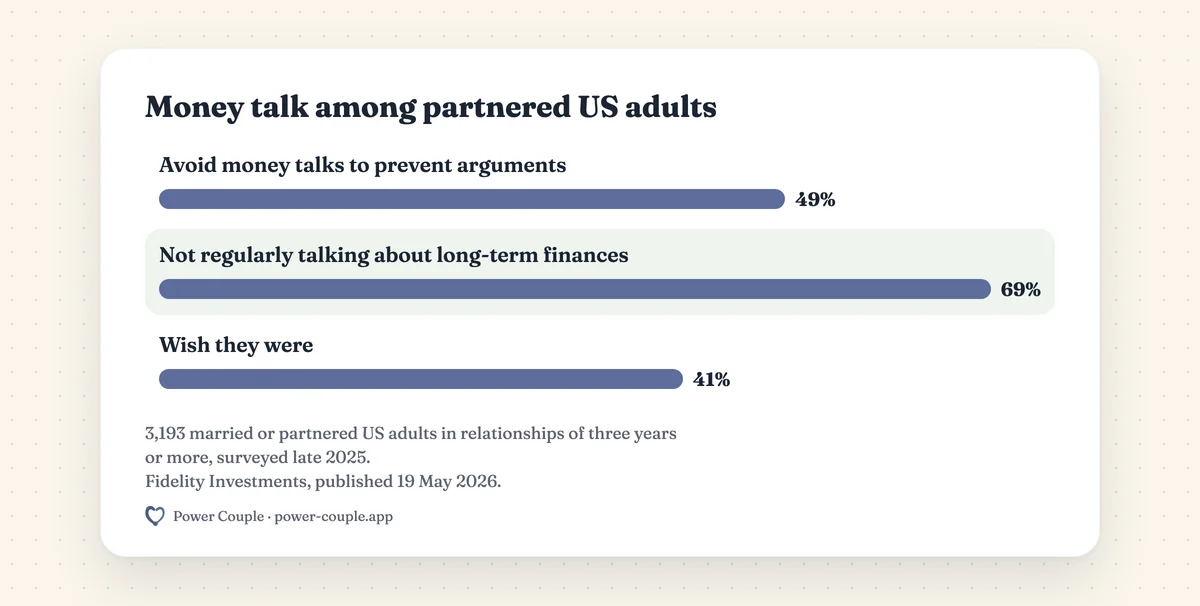
- Nearly half of partnered US adults, 49%, avoid money conversations to prevent arguments (Fidelity Investments, 2026).
Why does money derail the conversation?
Not because it's the most common thing couples argue about. It isn't. In a diary study, 100 married couples logged every conflict at home for 15 days, 748 in all. Money accounted for 18.3% of them in husbands' reports and 19.4% in wives'. Children accounted for far more, 36.4% and 38.9% (Papp, Cummings and Goeke-Morey, Family Relations, 2009).
The difference is what happens during the argument. In the same study, money conflicts came back more often, recurring in 59.9% of husbands' reports against 48.1% for other topics (Papp et al., 2009). Both partners rated them as more important to the relationship, now and long term, and they were more likely to end unresolved. Both partners also showed more withdrawal. Distress, sadness, fear, checking out of the conversation.
That's why this article is ordered the way it is. Money is a highly emotional subject, so a talk goes well when each of you understands the other's side and feels for it. Data helps too, and it can't be left out of what makes the talk work.
There's a second reason to take it seriously. In a study following 4,574 couples, financial disagreements predicted divorce more strongly than any other common disagreement. Once those disagreements were in the model, financial well-being itself was no longer associated with divorce (Dew, Britt and Huston, Family Relations, 2012).
Most couples simply never have the conversation. In late 2025 Fidelity surveyed 3,193 married or partnered US adults in relationships of three years or more (Fidelity Investments, 19 May 2026). Nearly half, 49%, avoid money conversations to prevent arguments, and 41% wish they were talking about long-term finances more than they do (Fidelity Investments, 2026). Sixty-nine percent aren't regularly talking about those at all. Sixty-eight percent didn't know their partner's complete financial situation before moving in together, and almost one in four admit to hiding a financial secret.
The opening sentence, word for word
The best-documented thing in this whole topic is how you start. Researchers followed 124 couples married less than nine months for six years, filming them discussing a real, ongoing disagreement. The first three minutes predicted the outcome. Of the 17 couples who later divorced, all began with "significantly greater displays of negative emotions, words and gestures" and fewer positive ones (Carrère and Gottman, Family Process, 1999; University of Washington, 27 September 1999).
Three minutes. That's reason enough to decide your opening line in advance, rather than finding it in the kitchen, mid-irritation.
Three openings you can use as they are.
When nothing is wrong and you just want to start. "I'd like us to sit down once a month about money, not because something's wrong, but because I'd like us to be looking at the same picture. Does Saturday morning work?"
When something specific is bothering you. "I get uneasy near the end of the month when the money runs low, and I don't know how that feels for you. Would you look at the numbers with me once?"
When your partner has shut the topic down before. "I'm not trying to take anything away from you, and I'm not asking you to account for anything. I'd just like us both to see where we are."
All three do the same three things. They name what you want, they don't ask for a decision on the spot, and they offer a time. What they don't contain is a sentence about your partner.
| Don't open with | Open with |
|---|---|
| "You've blown a fortune again." | "I'd like us to look at the numbers together once a month." |
| "You've no idea what our life costs." | "The end of the month makes me anxious. Can we look at it together?" |
| "We need to talk." (now, this second) | "I'd like to talk about this. When suits you this week?" |
| "Why do you never save anything?" | "There's something I'd like us to save for. Can I tell you about it?" |
The difference isn't politeness. The sentences on the left are about who your partner is. The ones on the right are about a situation the two of you can change.
45 minutes, four blocks
A conversation longer than an hour is rarely better, only more tiring. Forty-five minutes is enough, and it splits into four blocks so the numbers land neither at the start nor at the end. At the start you aren't warmed up, and at the end there's no energy left to decide anything.
| When | What you do | Why |
|---|---|---|
| 0 to 10 minutes | Each of you says one thing that went well this month. | This is how the conversation opens, and it's the three minutes the research measured. |
| 10 to 25 minutes | Read the numbers out. Both incomes, the fixed costs, what's left. No commentary, no verdicts. | Until there's a shared picture, you're each arguing with the numbers in your own head. |
| 25 to 35 minutes | Make one decision. One. | Several decisions in one evening turns the conversation into a negotiation. |
| 35 to 45 minutes | Agree the next date, and each ask the other for one thing for next month. | Without a next date, whatever you left unfinished goes nowhere. |
Before the second block, agree on an amount above which you check with each other first. Say $200. Below it you each decide alone, above it you talk first. The right figure depends on what you earn. What matters is that there's a number, so it isn't settled by feel in the moment.
One decision in the third block is plenty, such as opening a joint savings pot for the trip, cancelling one of the two subscriptions, or giving each other a $300 personal allowance next month.
Why I'd rather fix a date than wait for the right moment
I built Power Couple because my partner and I are preparing to get married, and we sometimes disagree about financial decisions. My view is that most of the damage isn't done by the disagreement itself. It's done by when the conversation happens. Unplanned, at 10 in the evening, with one of you holding a receipt.
So my recommendation is the dull one. Give the conversation a time, a length and an end, and repeat it every month. A fixed slot takes the charge out of the subject, because neither of you has to judge whether this is the moment to raise it, and because nothing has to be settled tonight. The research points the same way. It's the opening that predicts how the conversation goes, and the opening is far easier to get right when you both knew it was coming.
I'm not a financial advisor. You can read how this blog is written and checked on the About page.
Three topics to keep out of the first talk
Your partner's family. Who gave what to whose parents is a real subject, just not the one to open with. The hardest sentences get said here, and from that point the conversation isn't about money any more.
Old, settled decisions. "You bought that phone three years ago" can't be solved today. Make the first talk about what happens next month.
The big long-term plans. A home, children, retirement. These deserve a session of their own, not a corner of the forty-five minutes. And they keep getting dropped precisely because they're always last. Sixty-nine percent of partnered US adults aren't regularly talking about them. Write them down and put them on the next date.
What to do if it turns into a fight anyway
It happens, and it doesn't mean you did it wrong. From there, one thing matters. That the conversation doesn't end at a slammed door.
- Agree a word in advance that either of you can say when it's starting to get away from you. An ordinary word is fine. It doesn't need to sound serious.
- When it's said, stop. No last sentence, no "just one more thing".
- Name a specific time. Not "later", but "tomorrow at eight". This is the step that matters most. In the 2009 diary study, money conflicts more often ended with both partners agreeing to discuss the issue later, and those same conflicts were still the ones more likely to stay unresolved. "Later" on its own isn't a time.
- Don't text about it during the break. Everything written reads harder than it was meant.
- When you sit back down, start with what you agree on. Something like. "We both want the end of the month to stop being stressful. That part we agree on." Then take the disputed bit.
What if your partner won't talk about it?
First. It may not be the topic they're resisting. Of the people who avoid money conversations, the most common reason is avoiding an argument. Shutting down is often what that fear looks like from the outside.
Three things help here. Ask for ten minutes, not forty-five. Bring your own numbers, not theirs. What you earn, what you spend, what you'd like to save for. And say up front that nothing will be decided this time. A conversation with nothing riding on it is far easier to start.
If three attempts like that go nowhere, it isn't about money any more, and it's worth raising with a couples therapist.
My partner is very health conscious. When we were planning to move in together, she told me about all the nutrition products and the gym pass she wanted to buy. I was worried about whether we could afford such things at the start of our marriage. In that conversation I asked her for one thing she would be willing to let go of. She chose one, and we left it there.
As time went on, I saw how much comfort she found, and how much she recharged, working out outside the home. I realized that money serves freedom, health and safety after all. If we don't enjoy the process and just grind our teeth while saving up for something, the journey isn't enjoyable, and enjoying it is the whole point. So I let it go. I accepted that we might reach some of our goals a little later.
How to keep it from being a one-off
A good conversation on its own changes nothing. Repeating it monthly does. A Money Date is that repeat. A short appointment the two of you keep, on a date agreed in advance, to go through the month's numbers together. Mexico's financial consumer protection agency, CONDUSEF, also recommends reviewing the budget at least once a month, and whenever income or responsibilities change (CONDUSEF, "Amor que sí cuenta", February 2026, in Spanish).
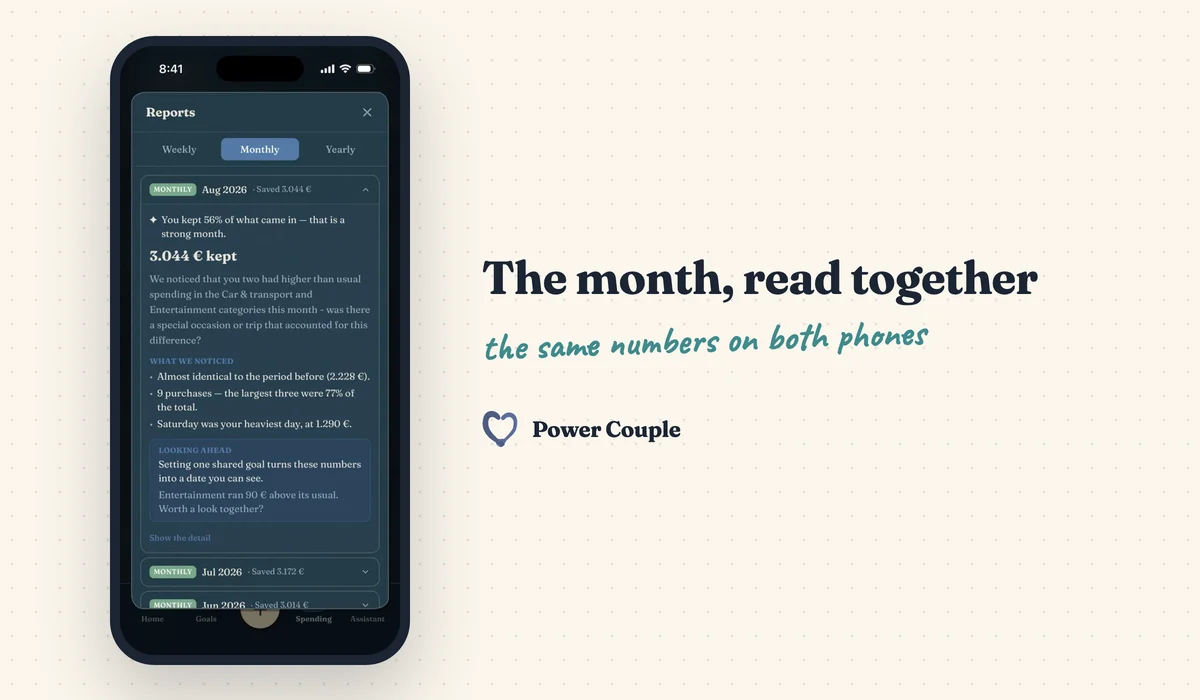
The hard part isn't the date, it's getting the same number onto both phones. As long as you each hold your own figures, the first ten minutes of every monthly talk go on who's right. Power Couple is built for that. One shared, encrypted budget for both incomes, no bank login, and a monthly Money Date that reminds you when to sit down.
If the talk keeps circling back to whose money paid for what, the question underneath is a different one. how to split finances as a couple.
Frequently asked questions
How often should we talk about money?
Once a month, forty-five minutes. More often only when something big changes. A new job, a move, a child, a large purchase, or a stretch with no income.
When is the best time?
When neither of you is hungry, tired or on the way somewhere. Weekend mornings work for most couples. Bad times. Right after a bill arrives, just before bed, and in front of guests.
What if one of us earns much more?
The conversation stays the same, the decisions change. For a couple committed for life, I'd recommend one shared pot with an equal personal allowance each, whoever earns more. I ran one couple through all five arrangements with real numbers.
What if a hidden debt comes out during the talk?
Don't decide about it that day. Write down the balance, the monthly payment and how long is left, and give it its own session. It's common. Almost one in four partnered US adults admit to hiding a financial secret from their partner.
Do we need a joint bank account for this?
No. What the conversation needs is for both of you to see the same numbers. Whether they sit in one account is a separate question.
What if money is being used as a weapon?
If one of you controls the other with money, that isn't a communication problem and this article isn't about it. Anyone living with that should keep access to an account in their own name and get help. Pooling assumes trust.